
Logan County 24-Hour Records
No official Logan County Sheriff page labeled “released,” “recent releases,” or “24-hour release” was found. The sheriff provides jail information, statistics, VINE access, and news, but none is a public same-day discharge table. This absence matters. A roster from Logan County in Oklahoma or Arkansas is not an Illinois record, even when it looks official. For Lincoln, Illinois, verify the domain, the 217 area code, and Logan County Sheriff branding.
The useful substitute is an existing jail release log or movement report bounded by exact start and end times. It may record a completed discharge, transfer, or other end to sheriff custody. FOIA, the Illinois Freedom of Information Act, lets a person request existing public records subject to exemptions. It does not require the sheriff to create a new list. Ask for the record that already tracks releases during the chosen interval.
Check Logan County Releases Today
Start with the precise day and time zone. A “last 24 hours” request is a moving interval, not always the same as midnight through midnight. Record both endpoints in Central Time and keep the retrieval time. Then use sources in an order that separates fast status signals from the lasting release record.
- Search Illinois VINE for a known person. Compare the reporting agency, identifying details, custody status, and event date.
- Review the Logan County case through Judici. Look for a bond order, dismissal, sentence, time-served entry, warrant, or commitment to IDOC.
- Send a written request through the sheriff’s FOIA process. Give exact beginning and ending date-times.
- If the record shows transfer to state prison, search the IDOC Individual in Custody Search. An IDOC intake is not community release.
- Save the date checked and the exact status language. Custody may change again after the first result.
For a broader interval, the Released Last 72 Hours page explains how to frame a three-day check without treating arrest news as release proof. A named-person search and full record path are covered on the home page.
Logan 24-Hour Release Fields
Because Logan County has no public 24-hour table, these are fields to request from an existing release log, movement report, or booking record. They are not a claim that every field sits in one sheriff form. The completed release or movement entry is the key evidence.
| Requested field | What it can establish |
|---|---|
| Name and booking number | Connects the entry to the correct booking episode and reduces mistaken identity. |
| Booking date and time | Places the start of the county jail episode. |
| Release date and time | Shows when Logan County Sheriff custody was recorded as ending. |
| Release type or code | May separate bond, pretrial release, time served, sentence completion, dismissal, or transfer. |
| Destination or receiving agency | Shows whether the person entered the community or moved to IDOC, another jail, or another authority. |
| Court case number | Links the physical custody event with the legal order in the court file. |
Ask for a code legend if the log uses abbreviations. “Transferred” is not “free.” A deceased notation is also not a release. If the sheriff withholds a field or applies a redaction, read the stated reason rather than filling the gap with an assumption.
Request Logan County’s Daily Log
The sheriff accepts written FOIA requests by email at foia@sheriffloganil.gov, by mail, or in person. The FOIA location is Logan County Sheriff’s Office, Attn: FOIA Officer, 911 Pekin Street, Lincoln, IL 62656. The published office hours are Monday through Friday, 8:30 a.m. to 4:30 p.m., excluding county holidays. The form is useful but not mandatory, and verbal requests are not accepted as FOIA requests.
A focused request can say: “Please provide an electronic copy of any existing jail release log or jail-movement report showing people whose Logan County Jail custody ended between [date/time] and [date/time], including release date/time and release type or destination, with exempt information redacted. If no aggregate log exists, please advise what existing record identifies releases during that interval.” This wording asks for records, not research or a newly made report.
The first 50 standard black-and-white pages are free. Added pages cost up to $0.15 each, color pages are $0.25, and electronic media or certified copies may cost the actual amount. Most noncommercial requests receive a response within five business days, though the law allows an extension of up to five business days. A response may produce records, seek clarification, cite an exemption, or deny part of a request.
The sheriff’s FOIA page shows the official route used when no same-day feed exists.
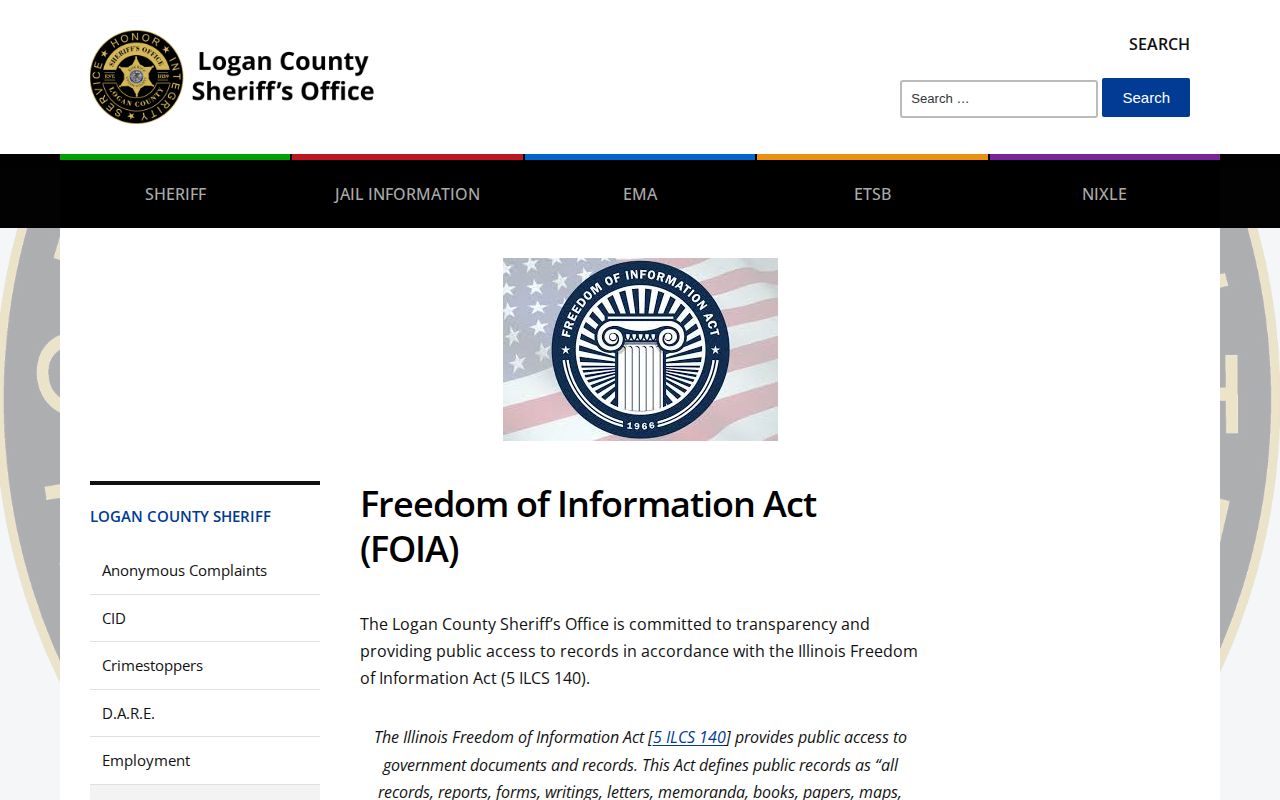
That source is the correct place to confirm current submission details before sending a date-bounded request.
Logan Released Versus In Custody
A live custody result answers who the reporting jail holds now. A release record answers what happened at the end of an earlier booking. Someone who no longer appears may have posted bond, received pretrial release, completed a sentence, had charges dismissed, transferred to IDOC, moved to another county, entered federal or immigration custody, or been removed because of a data correction. Absence cannot choose among those outcomes.
| Result | Best next source |
|---|---|
| Held by Logan County Jail | Illinois VINE and the sheriff |
| County custody ended today | Sheriff release or movement record plus the court docket |
| Transferred to state prison | IDOC search after intake processing |
| Federal or immigration handoff | BOP or ICE locator and the receiving authority |
Illinois VINE is a fast signal, but it depends on agency feeds. “Out of custody” may not name the type of event. Match the status and timestamp to a sheriff entry or court order before describing the result as a community release.
The Logan County Sheriff VINE page is the local bridge for a specific-person status check.
Use that status with a dated sheriff record, since VINE is not a permanent 24-hour archive.
Note: A missing live result is inconclusive until an official source identifies the completed movement, release type, date, and receiving agency.
Getting Home After Logan Release
Release planning needs confirmed facts. Logan County’s homepage identifies Lincoln as an Amtrak stop and names SHOW BUS and local cab service. Those are independent transportation leads, not services promised by the jail. No reviewed source states that the Logan County Safety Complex pays a fare, provides a ride, escorts a person to a station, or releases everyone through one fixed exit.
Call the jail before a pickup. Ask whether discharge is complete, where the released person may meet a ride, and whether timing has changed. Court processing, bond completion, paperwork, property return, a warrant, or another agency hold can affect the actual exit. Do not buy a timed ticket based only on a projected event or a vanished VINE result.
The Logan County transportation overview identifies local options that a released person or family can verify directly.

Confirm schedules, fares, accessibility, and pickup points with each provider because the county does not connect them to a set jail release time.
Logan Release App Limits
No official Logan County sheriff mobile app advertising a recent-release or booking-photo feed was confirmed. Illinois VINE offers mobile notifications, phone, text, and email options, but it tracks a chosen person’s custody events. It is not a list of everyone released today. Registration is prospective, so it may not reconstruct an earlier event.
The sheriff also maintains a News and Updates archive and public alert links. News posts can identify an arresting agency, location, charge, warrant, or approximate booking episode. They remain arrest-oriented. A dated arrest report cannot prove that the person later left the Logan County Jail.
The jail statistics page also is not a same-day release feed.
Population figures or snapshots cannot be turned into names, release counts, or proof that one person was discharged.
Logan Release News Needs Proof
Local sheriff news can narrow a search to the right booking episode. Note the arrest date, agency, case facts, and spelling of the name. Then move to VINE, Judici, and the sheriff’s written record process. This sequence preserves the distinction between an arrest, a court-authorized release, and the physical end of jail custody.
Strong confirmation uses two independent records. A sheriff movement entry documents physical custody. A court order can show legal authority. VINE supplies timely status, while IDOC identifies a state transfer or later release from prison. Record the retrieval date and quote the official status exactly. Never turn “not found” into “released,” or “transferred” into “free.”
Public Record Search
Sponsored Results