
Logan County Parole vs Probation
Probation usually comes from a Logan County court judgment that lets a person serve a sentence in the community under local court supervision. Parole and Mandatory Supervised Release, often shortened to MSR, follow an Illinois prison case. IDOC's Parole Division supervises the person, while the Illinois Prisoner Review Board sets or enforces release conditions and handles specified decisions. The prison's location in Logan County does not turn state supervision into county probation.
The distinction controls where to verify the record. The Logan County Probation directory is the local contact route. An IDOC profile, PRB record, or parole district is the state route. The court docket can show the sentence that created probation, while IDOC can show a state status such as parole and a projected discharge date.
| Question | Probation | Parole or MSR |
|---|---|---|
| Where it begins | Logan County court sentence | Release from an IDOC prison term |
| Main record | Judici docket and probation office | IDOC profile and PRB materials |
| Supervising system | Local court probation | IDOC Parole Division |
| End point | Court-ordered completion or discharge | Final discharge from state legal custody |
- Probation
- A court sentence served under community rules instead of, or after, confinement.
- MSR
- Mandatory Supervised Release, a period of state supervision after most determinate prison sentences.
- Final discharge
- The end of correctional legal control, not merely the day a person leaves a facility.
- Absconder
- A person alleged to have stopped reporting or left supervision without authorization.
Check Logan County Post-Release Supervision
Start with the sentence source, not a guess based on the facility name. A release from the Logan County Safety Complex may lead to local probation, no supervision, or transfer to IDOC. A release from Lincoln Correctional Center or Logan Correctional Center is a state event. The Logan County Judici search can show probation language, while the IDOC Individual in Custody Search can show state status and location.
- Find the Logan County case and read the sentence or most recent supervision order.
- If the judgment says probation, use the county probation contact to ask about procedure and record access.
- If it shows an IDOC commitment, search by IDOC number when possible and read the exact Offender Status and Location.
- For a parole or MSR issue, consult the relevant Prisoner Review Board record and note its date.
- Confirm conflicts with the agency that holds the source record. A phone answer may be limited by privacy rules.
An IDOC result showing a parole status and numbered parole district supports release from institutional confinement to supervision. It does not show final discharge. Likewise, an old court entry ordering probation may not show a later modification. Retrieval dates matter because supervision can end, transfer, or return to custody.
Logan County Probation Office Route
Logan County publishes a direct probation listing at 217-732-2106. That office is the proper local starting point when the court docket reflects probation. It should not be asked to interpret an IDOC parole or MSR record. Staff may explain process or receive a supervision inquiry, but no public source promises that protected case details will be disclosed by telephone.
Logan County Probation
Telephone: 217-732-2106
Official county contact directory
Before calling, save the case number, full name, and exact docket language. This helps distinguish a county probation question from a state parole question and reduces the risk of mixing people with similar names.
Logan County Supervision Violations
Illinois law authorizes conditions for parole and MSR, such as reporting, approved residence, and compliance with lawful instructions. The exact terms belong to the person's order. A suspected breach does not by itself prove revocation. For state cases, the PRB MSR hearing materials explain the process after a person is returned to IDOC on an alleged violation.
An absconder label means the supervising agency alleges that contact or compliance was lost. It is not the same as final discharge, and it can be paired with a warrant. Check the Logan County docket for a county probation warrant. For state supervision, read the current IDOC status and PRB record. Illinois VINE can provide a custody-change alert, but it is not a full violation file.
When sources disagree, preserve the wording and timestamp from each. A VINE alert may arrive before a docket entry is easy to find. A docket may show a warrant before a custody feed changes. The agency record, not an assumption from silence, resolves the status.
How Logan County Supervision Ends
Leaving jail or prison is not the last step when supervision follows. Probation ends according to the Logan County court's order and later docket entries. State legal custody can continue during parole or MSR even though the person lives in the community. The PRB final-discharge information describes a separate endpoint and an early-discharge route for eligible state cases.
Use the phrase final discharge only when an official record supports it. An IDOC Projected Discharge Date is still prospective. A Parole Date shows release from prison confinement, while an Offender Status of parole shows continuing state supervision. One discharged sentence line also may not settle the person's whole status if another sentence remains active.
The sheriff release entry, court judgment, and state profile answer different parts of the timeline. The broader Logan County released-inmate record path explains how to reconcile physical release with court authority. Note: A completed prison release can coexist with active MSR, so record the status as well as the gate date.
Logan County Parole Hearing Records
Most modern Illinois determinate sentences do not depend on a discretionary parole grant. IDOC Records calculates release to MSR, and PRB manages conditions and specified review work. Older indeterminate cases and special statutory groups may appear in en banc schedules and minutes. A hearing date is not a release decision.
For a potentially eligible older case, first identify the sentencing era and IDOC number. Then open the PRB hearing hub, find the dated schedule, and later inspect the matching minutes. Actions can include a grant, denial, or continuance. Use the board's exact term and capture both event and retrieval dates.
The successful manifest capture below comes from the official PRB MSR explanation. It shows why release to supervision must not be called final discharge.
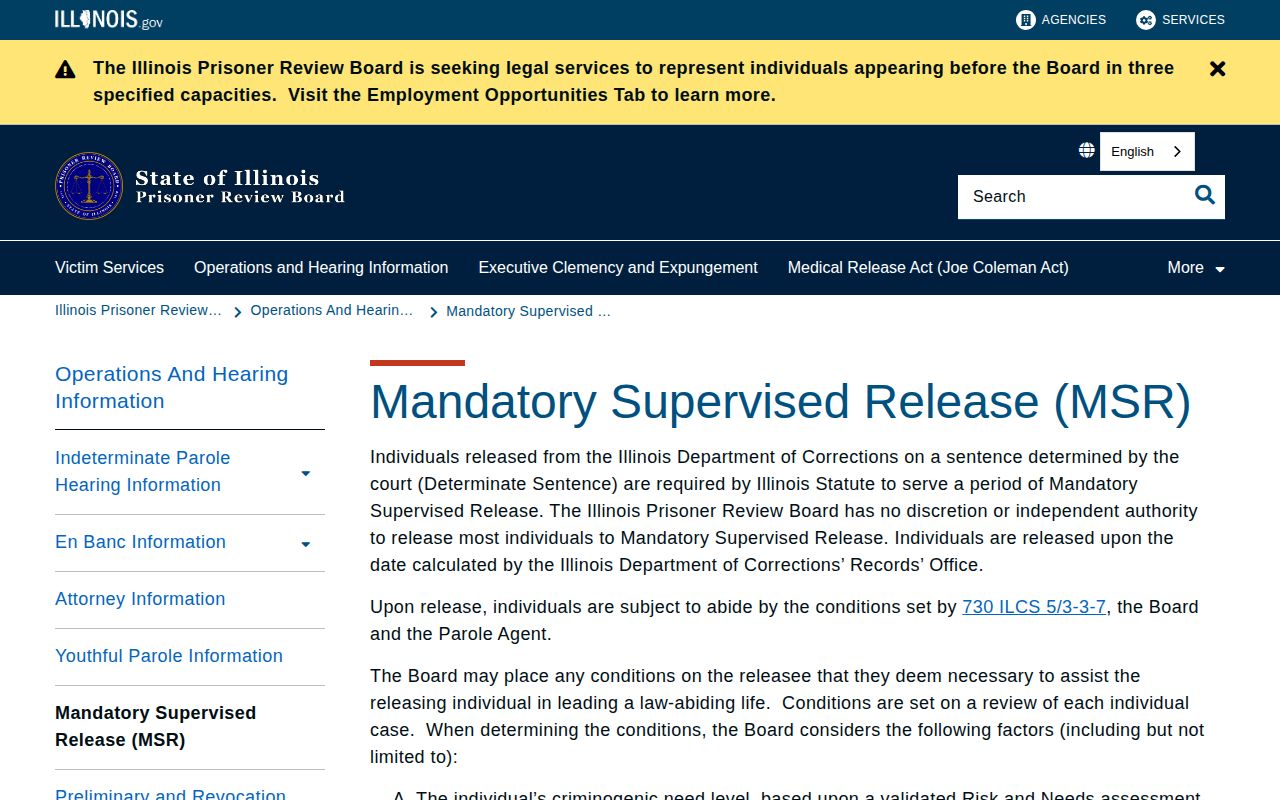
The state source anchors the Logan County parole inquiry in Illinois's actual supervision system rather than the county jail roster.
Logan County Supervision Office Detail
Logan County's directory draws a useful local line. The listed Probation office handles county court supervision, while IDOC and PRB handle parole and MSR. Because both paths involve a person living outside a facility, the records can sound alike even though the legal source and supervising body differ.
Check the docket before choosing an office. A probation sentence points to the county number. An IDOC commitment, parole status, or MSR term points to the state system. The distinction prevents a common error caused by Lincoln's two state prisons: being released from a prison located in Logan County does not place the person under Logan County Probation.
Note: The office receiving an inquiry may confirm process without releasing all case details, so rely on dated official records for the conclusion.
Logan County Supervision Alerts
The Logan County sheriff VINE route can help track a covered custody change after an alleged violation. It does not decide whether probation, parole, or MSR was revoked. Match the alert to the court docket, current IDOC status, or PRB hearing record.
A return to custody may follow a warrant or alleged breach, but the alert alone does not state the final outcome. Save the timestamp and reporting agency, then check the source record that governs the supervision case. This sequence keeps a short-lived custody event from being mistaken for a completed discharge.
Public Record Search
Sponsored Results